Turkey's local elections: how the opposition redrew the map
An analysis of the 2024 local elections in Turkey, showing how the opposition expanded across the country and where control actually changed hands.
Election result tables Province-level map system React comparison views International political reporting
Executive Summary
An English-language election explainer that turns a major Turkish political shift into a navigable, visual story using national results, province maps, and comparative party gains.
Explains a major political shift with maps, charts, and contextual reporting.
Election comparison
2019 vs 2024
Local-election shifts are measured across two cycles.
Interactive views
3
Bar results, province map, and net change view are presented together.
Geographic scope
81 provinces
Nationwide changes are mapped at province level.
Context & Problem Space
Turkey's 2024 local elections produced a national realignment that could not be explained by headline vote shares alone. Readers needed a structure that showed how the shift looked by party, by province, and by change versus the previous cycle.
Reporting Workflow
Combined result summaries with a province-level map and party-change comparison.
Rebuilt the visuals as custom React views so national share, geographic spread, and net control shifts could be read in sequence without external embeds.
Framed the narrative for an international audience unfamiliar with Turkish local-government structure.
Article & Visual Analysis
Turkey’s local elections: how the opposition redrew the map
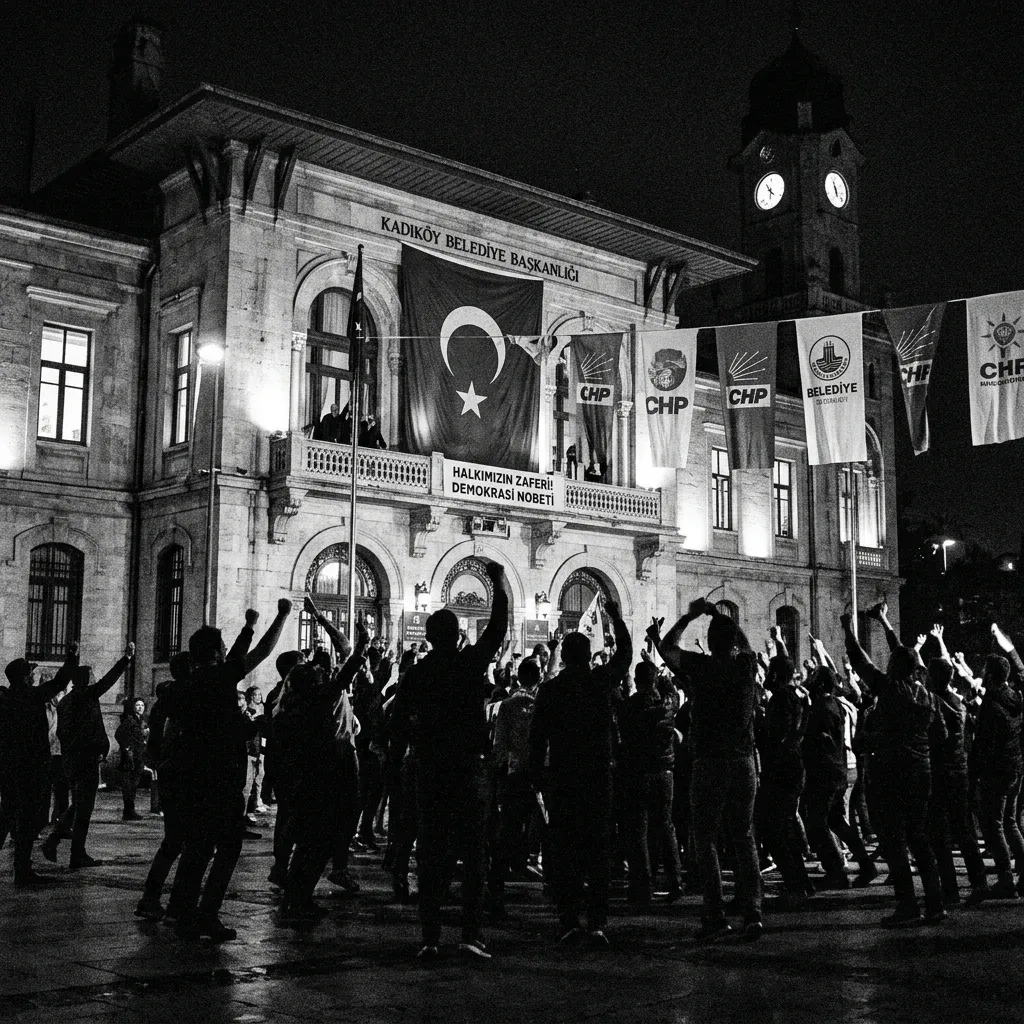
Turkey’s 2024 local elections did not produce a routine opposition win. They produced a territorial realignment. Provinces and metropolitan areas long treated as safe ground for the ruling bloc shifted toward the Republican People’s Party (CHP), and the scale of that spread made the result feel bigger than a single election-night upset.
For international readers, headline vote share alone is not enough. Turkey’s local system is layered: metropolitan municipalities, city municipalities, districts, and towns do not all behave in the same way. That is why this story moves through three linked views instead of one summary chart.
The first chart anchors the story in 2024 vote share, while preserving the 2019 delta so momentum is visible next to size.
National vote
The 2024 result, with the 2019 baseline still in view
Each row stays anchored to 2024 vote share, while the delta marker shows how far the party moved against the last local-election cycle.
CHP
2019 baseline
Republican People's Party37.77%
17,391,548 votes+7.65 pts
AKP
2019 baseline
Justice and Development Party35.49%
16,339,771 votes-8.84 pts
YRP
2019 baseline
New Welfare Party6.19%
2,851,784 votes+6.19 pts
DEM
2019 HDP
Peoples' Equality and Democracy Party5.70%
2,625,588 votes+1.46 pts
MHP
2019 baseline
Nationalist Movement Party4.99%
2,297,662 votes-2.32 pts
Step 2
Where the shift spread
The province map matters because it shows the opposition move extending beyond the usual western urban strongholds.
Geographic spread
The provincial map of the shift
Hovering previews a province and clicking locks it. The fixed reading panel keeps candidate, vote share, and control change visible while you scan the map.
CHP
AKP
YRP
DEM
MHP
IYI
BBP
Step 3
How party control changed
The final comparison separates headline vote share from actual municipal control across administrative levels.
Control shift
Where municipal control actually changed hands
The diverging bars show gain or loss against 2019, while the total on the right keeps the 2024 scale of control in view.
CHP
+11
2024 control
21
AKP
-12
2024 control
12
MHP
-2
2024 control
8
DEM
+2
2024 control
7
YRP
+1
2024 control
1
İYİ
+1
2024 control
1
BBP
+1
2024 control
1
Why the first chart matters
The opening view stays centered on 2024 vote share, but each row carries a delta marker against the 2019 baseline. That matters because a party can still be large while losing ground, or gain momentum without becoming the dominant force nationally. In 2024, CHP managed to do both: it led the national municipal vote and expanded beyond its traditional map.
AKP remained a major force, but the result showed visible erosion in parts of the country that had long been treated as politically stable. Smaller parties such as YRP also became part of the explanation, not necessarily by winning vast territory, but by reshaping conservative vote competition.
Why the map mattered
The province map is where the election starts to feel historic. Hovering and locking provinces makes it easier to read candidate, vote share, and control change without chasing a tooltip around the screen. More importantly, the geography shows the opposition move spreading far beyond the familiar coastal strongholds.
Cities such as Bursa, Adıyaman, and Amasya mattered because they signaled that the shift was not only urban and western. It carried into places that had been described for years as dependable AKP territory. That broader spread is what turned the result into a national story rather than a metropolitan one.
Beyond vote share
The final chart moves from votes to control. Tabs separate metropolitan municipalities, city municipalities, districts, and towns so readers can see where the real administrative turnover happened. A party’s net gain can be strong even when its absolute footprint remains smaller than an older rival, which is why 2024 totals sit beside the diverging bars.
This is especially useful for understanding AKP’s mixed outcome: the party lost headline prestige and important strategic ground, but it did not disappear from the local map. CHP’s advance was decisive, yet the layered control structure shows a more nuanced balance beneath the national narrative.
Conclusion
The 2024 local elections changed more than a scoreboard. They altered the territorial story of Turkish politics. By reading national share, provincial spread, and administrative control together, the result becomes easier to understand for anyone following Turkey from outside the country.
Data source: Supreme Election Council result tables and the local project datasets used to build the province map and comparison views.

Related Work
Selected adjacent work that extends the same problem space from a different angle.